An exclusive interview with Professor Mark Emberton of UCL
"Treating Prostate Cancer with HIFU"
High Intensity Focussed Ultrasound is a real alternative to traditional prostate cancer surgery. CANCERactive first brought prostate patients news of HIFU back in 2007 and has been championing the use of HIFU since then. Until only recently, people diagnosed with Prostate Cancer could only go to one of the 60 clinics on mainland Europe using Ablation techniques. HIFU involves just a short stay in hospital and has far less side-effects than standard surgery. We are delighted that this treatment has now been finally supported in the UK. It is also now being used in American Medical centers such as NorthWestern, Chicago and MD Anderson, Texas (Chris Woollams). HIFU: A SAFE, SIMPLE AND COST-EFFECTIVE WAY FORWARD
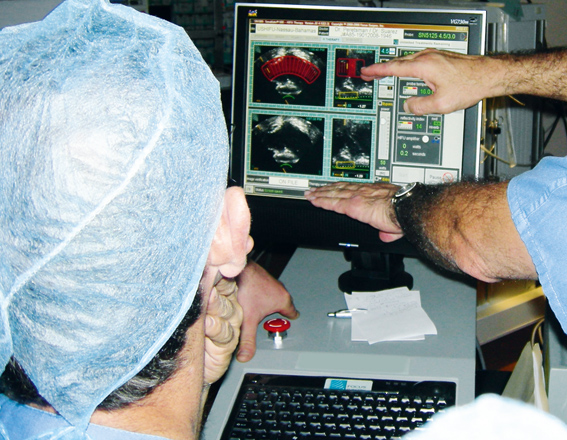
The (quite literally) hot new story for men with prostate cancer confined to the prostate gland is High Intensity Focused Ultrasound. HIFU therapy destroys cancer cells (but only these cells) with rapid heat elevation which essentially cooks the cancer at some 70 or 80 degrees. The temperature rises only at the focal point so, critically, the prostate gland itself remains intact. Unlike surgery or radiotherapy, HIFU is a one off, non-invasive process which takes no more than an hour. It can be repeated at a later stage if necessary. At University College Hospital, London, Professor Mark Emberton has treated about a thousand patients over the past five years: avoiding biopsy which he finds to be unreliable as a diagnostic tool, Mark Emberton operates only on patients whose cancer has first been identified and located by MRI. Men who have the procedure in the morning go home that afternoon he explains.

Professor Mark Emberton
"HIFU is delivered via a probe in the rectum, so there is no incision, and no pain. There may be a bit of prostate swelling so we put a catheter in for a few days. 70 per cent of men have their erection back within two weeks. That’s not because we are clever, but because we are only treating the cancer, with no risk of damage to the gland as a whole. HIFU is very well tolerated with almost zero toxicity. A phase one study with one year follow up showed that men returned to baseline function at six months in other words there was no significant deterioration in continence or erection. There was complete cancer control in between 90 and 100 per cent of patients." (Professor Mark Emberton is interviewed by Madeleine Kingsley.)
HIFU: PLEASING TO THE NHS POCKET ...
HIFU is good news, not only for men, but for the NHS pocket. Instead of 1.5m for a radiotherapy machine, plus the multi-million pound cost to locate in a concrete basement for radiation protection, and ongoing running expense, HIFU equipment costs 300,000. Whereas prostate surgery involves about 2000 of disposables, a catheter and a condom is all we use for HIFU Says Professor Emberton.
Radiotherapy patients have to attend hospital every day for about seven weeks, which is very disruptive to lifestyle, and raises patient anxiety about the condition. A one-off treatment is much less stressful, very attractive in terms of carbon footprint, and because the energy source is clean, we can do it anywhere.
... AND HIFU IS A LOT MORE STRAIGHTFORWARD TO DELIVER THAN GOOD SURGERY
Professor Emberton stresses that great surgery is a rare art: Even at the world’s best centres there is still a 14 fold difference between surgeons in terms of oncological outcomes. This is not necessarily a reflection on the quality of surgery. It is also partly because case selection is poor and radical prostatectomy is a difficult operation: the learning curve for surgeons is long and may take hundreds, some say thousands of cases. As few surgeons ever do more than a thousand cases in a lifetime, they remain early in the learning curve and patients are disadvantaged as a result. It’s wonderful to see a gifted surgeon do a difficult operation, but it’s not, on the whole, a very good thing for quality control. You can spot the great artist and then you can see the imitators: the difference between them is stratospheric. All men lose their erections at surgery because tissue around the prostate gets damaged. Whether this precious function returns depends on age and baseline erectile function, the stage of the cancer and the type of surgery done. Much depends on how close to the prostate the surgeon feels able to operate, this is partly down to skill but also about whether or not he decides to spare or take a nerve. These are very critical decisions and there are big differences between surgeons ability to do that. To dissect a prostate off the rectum and leave nerves intact is like doing ballet: you have to be Nijinsky. Its a superhman act and when you see it done fantastically well, you want to applaud. It’s that difficult.
HIFU DOES NOT REQUIRE A SURGICAL NIJINKSY
HIFU is not difficult to carry out but it’s equally effective and better tolerated than other treatments. Therein lies a problem if you are a surgeon who prides himself on the ability to carry out the most testing operations with all the status that conveys. Says Professor Emberton, as a surgeon I had done prostatectomies for 10 years before moving towards this energy-based treatment. I would pride myself on being a superb anatomist and dissectionist. But if there are other simpler techniques like giving a tablet or applying energy where the skill of the person delivering it matters less then there is obvious patient benefit in offering a less personality-benefit treatment. We can teach many more people to deliver it to many more men. It doesn’t matter who gives it to you: a professor or the ward cleaner. It works just the same.
SO, WHY HAVENT WE HEARD ABOUT MORE ABOUT HIFU UNTIL NOW?
HIFU has been slow to roll out for prostate patients because, as Mark Emberton explains, NICE has 100 new therapies a week to evaluate, and they wait for pretty solid data before sanctioning general use: It is anyway only in the past few years that HIFU technology and the MRI technology which is essential to the process - has advanced enough to allow us to ask fresh questions and think differently about the disease. This new treatment is all about the adjacent possible: you couldn’t innovate until you had good enough MRI and until you had in your hand a HIFU machine that allowed you to treat focally.The very modern forms of radiotherapy such as the cyber knife and protons will probably be able to treat focally too, but they are very expensive some 70,000 dollars per patient.
MEN MISS OUT AS PROSTATE CANCER TREATMENT LAGS BEHIND BREAST CANCER CARE
If you take the breast cancer technology says Professor Emberton you can look back on 80 years when women had only two options: to have the whole breast removed (because the cancer location was uncertain) or do nothing. Slowly this surgical protocol was challenged, and now 70-80 per cent of women can have lumpectomies, keeping their breast with the same survival statistic. In prostate cancer, we haven’t yet got this far, irrespective of risk and the burden of disease we still insist on treating the whole prostate, either by removal or whole gland irradiation.
The big, big story now is that with good imaging (MRI ) and new focal technologies, that allow us to treat small volumes of tissue, we are in a position to start exploring prostate preservation. And to make the transition away from insisting on treating the whole gland because we do not know where the cancer is (the mastectomy position) to saying well, actually how aggressive is this cancer? Do we need to treat it at all? And if so, can we get away with treating just the cancer and preserving as much prostate as possible?
DIAGNOSIS: THE STRATEGY SO FAR HAS NOT HIT THE SPOT
Mark Emberton is far from satisfied with the traditional medical strategies for diagnosis: Overdiagnosis is arguably the greatest challenge in the management of men with prostate cancer. The question, does a man have prostate cancer? is, I think, a little futile. At 50, I have a 30 per cent chance of having cancer in my prostate. I’m not really bothered about that risk because I know my risk of dying of it is only three per cent whereas my risk of dying of heart disease is something like 70 per cent. A 70 year old man has a 70 per cent chance of having this cancer, and a 35 year old has a 15 per cent chance. Were he to die and someone to look at his prostate very carefully a man of 45 would have a 25 per cent chance of the disease being present. We know all this from post mortem studies. We’ve known it for years. But the mortality rate has remained pretty static at three per cent of the population. So the interesting question to any man of any age is this: Do you have clinically important prostate cancer, or does it in any way interfere with your quality of life? I would argue that our current strategies aren’t very good at addressing that question.
Professor Mark Emberton
Because what do we do? We do a PSA, which we know is not great at distinguishing cancer from non-cancer and aggressive cancer from non-aggressive. Then we subject men to this random, blinded biopsy. Its equivalent to a woman walking into your surgery where you randomly put a needle into the breast in 20 places on the assumption that if cancer is there you are going to find it. Which of course we don’t: To say that random placement biopsy is like trying to find a needle in a small tangerine, or a large walnut is not a bad simile in terms of volume: the cancer could measure 1cc. That’s the challenge. You hope to hit the tumour if it’s there and if you do, you tell the man that he has prostate cancer. If you don’t find cancer, it doesn’t tell you very much at all. It could be a false negative. Biopsy again and you also have a 20 per cent chance of finding cancer, even though the first time was negative. So the process is bad. Men don’t appreciate this.
THE BLIGHT OF BIOPSY: WHY CURRENT SCREENING DOESN’T WORK
The problem with biopsy is that negative status is indeterminate whilst positive status means that you can pick up insignificant disease. Says Professor Emberton: Abnormal cells may have been there for 20 years. It may be disease that I have today and may not influence my life. The danger is that you go blindly, perhaps picking up odd cells that are of no consequence. By telling a man he has prostate cancer you potentially confer harm and cost with no utility. He is not destined to die of that disease. Conversely a biopsy needle might catch the edge of a big tumour, suggesting that there is only a bit of cancer which doctors can afford to watch without treating. So the reason we do treat is that there is usually more cancer than is found because you hardly ever get a direct hit at the pea. So there’s an extraordinary imprecision: men who don’t need treatment get it; men who do need it are not being diagnosed: men who could safely wait get treated and men who should be treated are told to wait.
AND WHY STATE-OF-THE-ART RADIOTHERAPY IS MOSTLY FOR THE VERY RICH
Gold standard radiotherapy is now of the conformal type: in the US, IMRT (intensity Modulated Radiation Therapy) costs 30,000 dollars per patient to treat, and this is for a common cancer. Cyberknife and proton therapy could be more than twice that figure. Escalation in technology is designed to avoid side effects. But many would argue says Professor Emberton that this strategy hasn’t worked. There’s little evidence at the moment to support the view that the technological arms race has materially reduced toxicity. The equity issues, what’s more, are enormous: as top treatments become more rarefied, they are increasingly sited in small private centres and so become the exclusive privilege of the rich. This level of service is not just private pocket treatment, but private jet treatment and therefore impossible to replicate in a public health system. Excellence is a well-used medical watchword, but its quite separate from the equity issue. Says Professor Emberton. My view and I stress it is a view, is that the one plausible strategy for diagnosing men more efficiently and biopsying men with fewer needles is by modern imaging techniques. It could knock a man off the table to hear this, because there is no other cancer but prostate that you would NOT image before you biopsy. I think that utilising MRI is going to make a big difference in identifying where the cancer is. Professor Emberton is chief investigator to The PROMIS prostate MRI study, in which the government has invested 3m designed to prove definitively whether MRIs can be useful . Obviously to change practice to this degree he says there would need to be a pretty high level of evidence.
MRI BEFORE BIOPSY SHOULD BE OFFERED TO ALL MEN
Every hospital now offers MRI, but its use specifically for prostate cancer is still limited, even though it would help decide who really needs a biopsy. A normal MRI suggests that a man has very little risk of dying from prostate cancer (though Mark Emberton stresses that this is an assertion yet to be proved longterm.) If an abnormality is found, biopsy needles could then be directly targeted, a much better scenario than the random pea-in-tangerine approach. MRI works quite well because in two out of three cases a positive signal suggested by imaging is proven by biopsy. Imaging will allow us to biopsy fewer men, biopsy better those men who need it and risk stratify more accurately because one is more likely to get a direct hit. This would to some degree correct over- and under- diagnosis: the two great errors in our traditional approach. Limiting biopsies is also important in risk reduction as Prof Emberton agrees: We know that with biopsy you create a shower of cancer cells and you incite cytokines which, in response to injury, can trigger cell growth. If you injure any part of the body you get blood supply cells coming in. Inflammation encourages cells to multiply and that cant be good.
CONCLUSION
HIFU can only work as the treatment of choice if MRI (at present rarely used in prostate cancer) is used to diagnose and locate a tumour. Present diagnostic practice proceeding from raised PSA levels straight to 20-needle biopsy is just too unreliable because most cancers are 1.4cc in volume, and most prostates are 40cc in volume, Says Professor Emberton: I think most men and indeed most urologists underestimate the problems of our existing diagnostic pathway. The MRI route will allow men to entertain an alternative to traditional ways of treatment, and will also expand the population of men that can safely be watched. If diagnosed with cancer that can safely be watched, you are probably better off not having traditional treatment that carries a risk of toxicity. But if you could have HIFU which is very well tolerated with almost zero toxicity then I imagine very few people would sit on their cancers. That’s the upbeat message. Men would opt for treatment for the peace of mind factor.
Professor Mark Emberton is a member of the team at London Urology Associates (LUA)
CANCERactive has been pioneering the use of HIFU in the UK since 2007. For more information on this alternative cancer treatment which, hopefully, will increasingly now become a mainstream norm,
CLICK HERE.