Prostate Cancer - The Facts Read John’s update
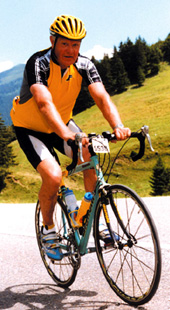
John Wallace, Prostate cancer approach -
Riding High
(Originally published in February 2003 icon)
John Wallace, 64, has not let prostate cancer interfere with any of his life’s passions - including archery and road cycling.
John spent all his working life in the bank but eight years ago he was made redundant.
Far from proving a disaster, early retirement - and the northern house move it entailed - possibly saved his life. John and his wife Sue, (whom he originally met at work) celebrate their 40th wedding anniversary in April.
They have two daughters, Sarah, 36 Mandy, 35 and a four year old grandson.
Here’s John’s story in his own words...
"When I was 52, my annual BUPA check found that I had a raised PSA level. It wasn’t high - four, I think, is normal, and mine was just over five - but my GP in Walsall suggested I saw an urologist. He was a nice chap, whose view was that there was nothing to worry about at all. So I went on my way quite complacently. I was easily reassured because I was pretty fit, having run the London Marathon only two years earlier, and I had no symptoms at all - and indeed I never have had. There wasn’t the usual enlarged prostate, I had no trouble urinating, - everything seemed to be perfectly normal.

Only one out of five biopsies showed a tumour

At the time I was in the middle of the redundancy process, but I can’t say I found it stressful. Eighteen hundred staff were going at the same time, and I was secretly delighted that Sue and I would move up north (Sue and I had met in Harrogate) to a village near York and that the bank kept up my BUPA membership as part of the redundancy package. Without that cover, I wouldn’t have gone on having regular health checks or have any reports to show my new doctor.
The new GP service proved altogether excellent. I still wasn’t worried by these repeated PSA findings, but when Dr Jones saw my records he said "Right, we’ll keep a track on this." So every year I had a blood test. Looking back, I am just so grateful for that. After a couple of years, the PSA level rose to eight, so Dr Jones now suggested I see an urologist in York. I had a DRE or digital rectal exam - and I also went for a scan which was inconclusive. So then I was sent for a biopsy (using a Trans Rectal Ultra Sound) in the York BUPA hospital. I can ’t say this was painful but although the radiologist was very sympathetic and understanding, I was glad when it was over after 20 minutes. I was lucky, however, that the procedure was so thorough. During that time they took six biopsies of the prostate using an ultra sound probe and biopsy needle gun. Of the biopsies, five, I later learned, were clear and only one showed a tumour. My reaction to the results was "oh, bugger" because past reassurances had left me really quite casual about the whole thing.
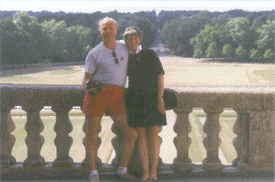
Just sitting in the car afterwards, Sue and I were in a bit of shock. But what kept us going was that this York specialist said the tumour -which was small, slow-growing and low grade -wouldn’t affect me for 15 years. So there seemed no rush deciding on treatment. My urologist pointed out that prostate cancer is now very prevalent. He went through various options:
We could wait and watch (doctors call it active monitoring) which I didn’t fancy. But the way it was put to me, I didn’t fancy surgery either. He suggested that the operation would reduce my quality of life dramatically. Given the worst case scenario, he said, ’I have to tell you that you’ll be incontinent and impotent’.
At least he said I could be, but there was about five per cent chance that I wouldn’t be. I found this very negative and quite frankly I was scared to death.
For Sue, though, the overriding urgency, given that I had cancer, was that I should get rid of it, however things turned out.
I owe my present good fortune to my son-in law, Guy, who’s a consultant paediatric oncologist. His intervention as a knowledgeable researcher was invaluable, because he fixed an appointment for me to see a consultant from one of the few specialist UK units with its own team, exclusively dedicated - from surgeon to anaesthetist - to prostate surgery. Even though my GP did the dirty work involved in changing specialists, I felt a bit guilty about changing to see John Anderson in Sheffield. But you naturally want to give yourself the best chance.
Mr Anderson confirmed that as an alternative to surgery they could continue to monitor me, or they could try Brachytherapy (an internal radiotherapy treatment where radioactive seeds are implanted into the prostate under anaesthetic). I made a date to visit a specialist hospital in Leeds about this, but then I cancelled, because I didn’t like the idea of an isotope inside me. And even then we couldn’t know for certain that it would work. The advantage is that this new process is surgically non-invasive, but it can bring on incontinence, so I was told.
I hadn’t realised just how long and complicated the operation would be
Sue and I then had plenty to talk about, although we’d already more or less decided on full removal despite the risks which Mr Anderson had himself reiterated. He acknowledged the potential harm to quality of life, but he also said - a remark that weighed heavily - ’Believe me, there is no sex in the graveyard’. I felt very much that I could trust him.
I had the operation just before Christmas in 1999. I hadn’t realised just how long and complicated it would be.
So I was surprised by the extensive vertical scar from just below the navel right down my abdomen and by needing to receive 14 pints of blood, because it turned out that I’m a heavy bleeder.
(John Wallace’s experience was unusual; most surgeons use a bikini line incision and patients would have considerably less blood loss.)
I actually had to stay in hospital longer than the chap in the next room who had a heart bypass op. If all this sounds gruesome, it certainly wasn’t, and I still believe that Sue, as bystander next of kin had a worse time of it than me. I was lucky in one sense to have the operation at all: after opening you up, the surgeons sample your lymph gland tissue and if these are affected by the cancer, then they don’t go ahead with removing the prostate gland.
Sue says I was braver about all this than I usually am about a cut finger or the flu. But I woke up feeling ridiculously normal, with no nausea or headache. I had an epidural so there was no pain, just some discomfort because of air in the abdomen which also means you feel and look bloated. If I had any problem - apart from the drains in the wound and the catheter, it was NOT having any pain, because you forget you’ve had a major operation and think you can do more than perhaps you should.
Men still don’t have PSA tests and there should
be far more popular awareness
I went home after a week with the catheter in, then returned after a few more days to have it removed. That’s when they put some strange dye into your bladder and take an x-ray and ultra-sound to ensure there’s no leakage. All was well, but about six weeks on, during a Leeds v Newcastle football match I got the shakes and had to leave at half time. It seems I’d picked up a nasty infection so I spent three more nights in hospital on massive doses of antibiotics.
Three years on I have six monthly checks. That’s my choice, as I could just go annually. My latest PSA level is 0.26, which is very good. I’ve needed no follow-up therapy and to all intents and purposes the cancer has gone. But the whole experience has been somehow, humbling. It’s a reminder of mortality, that cancer can happen to you and not just out there, to others. Reading so often how prostate cancer has struck men like David Steel, George Baker and Bob Mon khouse, makes you recognise just how common it is. Yet men still don’t have PSA tests as a matter of course, the way women have cervical smears. There should be far more popular awareness. Three male friends went off to be tested because of me, and only the other day, our daughter rang to say her friend’s father has prostate cancer and it’s gone to the bone. She said she hadn’t realised just how serious this could be, or how lucky her Dad had been with his treatment.
I was indeed accidentally fortunate: I do wonder how different things might be had I not got early retirement: I have a horrible feeling that had I remained working in the Midlands I might not have found out about the cancer until too late. My Yorkshire GP was apparently surprised by my diagnosis as even he had thought twice about referring me to a specialist because my PSA reading was 8.9 at its highest and he’d seen readings over 3000.
My quality of life is more or less the same as it was before
My surgeon seems quite impressed with the way I’ve handled all this. But my thought is, "what the hell, you can’t bemoan your life away. My quality of life is more or less the same as it was before. Maybe things are not exactly what they once were in the bedroom department, but i’m 64 and it’s all subjective. Sex is certainly a lot better than we thought it was going to be. Life overall now is pretty wonderful. We’re involved in village affairs and the local University of the Third Age. I’ve also had time to indulge my passion for road biking which has replaced running as my top sport. Sue and I have changed to a more healthy diet, picking up tips from our vegetarian daughter who’s a great cook. We don’t eat red meat. We now filter our water and I take a multivitamin and mineral every day, as well as lecithin. I sprinkle linseed on my muesli every morning.
Sue says we’re maybe less materialistic now. On the other hand - and I hope this doesn’t sound decadent - we tend to look more to ourselves and small indulgences.
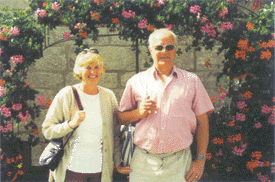
You do ponder on what may be lurking ahead.
So we do take off together for weekends away and, last July I did l’Etape du Tour - a single leg of the Tour de France.
I’d trained for it over six months cycling all over the Yorkshire Moors. All the Brits ride together right at the back of course, but it’s wonderful to see Mont Blanc as a backdrop. I’d love to do l’Etape again one day. But now, I couldn’t ask for anything more than I have.
I simply look forward to a continuation of the lifestyle I have now."
GO TO: Prostate cancer treatment in over 55s no better than no treatment in terms of survival