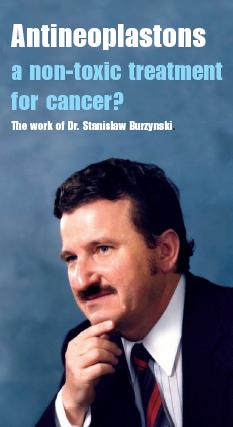
Dr Burzynski and his antineoplastons
This Alternative Cancer Treatment involves the work of Polish Doctor, Dr Stanislaw Burzynski, working in Texas in the USA.
Having studied the urine of healthy humans and those with cancer, he discovered the healthy humans had protein peptides that were missing in people with cancer. So he set out to extract these missing peptides from healthy subjects, copy them and produce a peptide ´mix´ specific to different cancers. These peptides he named and patented as ´Antineoplastons´.
Antineoplastons (which are supposedly non-toxic) were used in his early work with brain tumour patients and subsequently with other cancers. In his work in his own clinic he produced research results which he claims beat the statistics seen for standard radiotherapy and chemotherapy treatment: In recorded trials for adults with gliomas having chemotherapy and radiotherapy the comparable 5 year survival was 9 out of 54 for orthodox treatment; 5 out of 25 for antineoplastons. With children, the results were even more striking. Orthodox treatment say an immediate clear up of the tumour in only 1 case out of 107 (and that child did not survive 5 years). With antineoplastons 11 out of 40 patients were clear after treatment, all those 11 surviving 5 years.
Skeptics, of course, question this ´research´, some denying its existence. But the National Cancer Institute in America now devotes several pages to antineoplastons. To quote them:
Studies have reported on the effect of antineoplastons in certain types of cancer:
- The effect of antineoplastons A10 and AS2-1 on brain tumors was studied at Dr. Burzynski´s clinic and at the Mayo Clinic. A brain tumor study done in Japan did not report the type of antineoplaston used.
- The effect of antineoplaston AS2-1 on prostate cancer was studied at Dr. Burzynski´s clinic.
- The effect of antineoplaston A10 on liver cancer is discussed in a case report from Japan.
These studies reported mixed results, including some cancer remissions (signs and symptoms of cancer decreased or went away). Other investigators have not been able to obtain the same results reported by Dr. Burzynski and his team. Some of the patients in the reported studies received standard treatments in addition to the antineoplastons. In those cases, it is not known if responses and side effects were caused by antineoplaston therapy, the other treatments, or both. One additional independent report (a study from Japan) was completed but does not have the same findings as the Burzynski report.
The NCI do report that there have been phase I and phase II clinical trials, but never a phase III randomised, controlled clinical trial. Burzynski is currently treating a large number of cancer patients with a broad spectrum of cancers. His treatment is now part of a phase III clinical Trial. We await the results!
However, there is a caveat. It would seem that even the authorities in the USA acknowledge that antineoplastons do work sometimes - Burzynski, himself, says he is still not 100 per cent sure why antineoplastons ´work´ for only some people.
The NCI and FDA acknowledge that anteneoplastons ´work´
The story runs as follows: Before he started his work, Burzynski took legal advice and was told he could practice in Texas where he could distribute antineoplastons to patients.
However, his early success prompted a hiatus amongst the American Orthodox community, and resulted in numerous court and FDA appearances across a ten year period. For example, Burzynski went through 4 Senate hearings and several other FDA hearings. In the end, the FDA gave up challenging the medicine of the treatment. Importantly, according to Burzynski, they acknowledged that the treatment was non-toxic and could help some patients beat their cancers.
The truth is that phase I clinical trials report side-effects that are minimal and short-term, but phase II clinical trials with brain tumours report side-effects such as seizures and sleepiness (but this could be a feature of brain tumours and their treatment anyway).
After a Congressional Subcommittee meeting which noted that after 4 Senate Hearings (which normally lead to an indictment), he had never once been indicted, the Chairman of the hearing told the FDA that they were wasting time and tax-payer money. So he was subsequently indicted on 75 counts. (This is all on film).
Despite many patient witnesses he was found guilty of breaking Texas Law. However, the judge suspended the verdict and allowed him to continue treating 300 or so patients, all of whom had testified that if they did not have access to antineoplastons they would die!
Attempts to ´steal´ the formula
This ´muddle´ then resulted in another Congressional Subcoimittee hearing (Feb 29 1996), From this and public (and media) pressure, the FDA was pushed to provide a special task force to conduct clinical trials of standard treatment versus anteneoplastons. Despite the clinical trials progressing in 1997 and agreeing that the issue was NOT that these antineoplastons worked (that fact was accepted), the court trial still took place. The jury could not decide and the judge acquitted Burzynski. The FDA over ten or more years spent over $60 million in what the media often termed a ´witch hunt´.
The key question is: ´Is Burzynski on his way to a Nobel Prize, or is it all quackery?´
Let us backtrack: In 1991 Dr Michael Friedman, of Memorial Sloan-Kettering, and probably the top brain cancer expert in the world, stated that antineoplastons deserved a closer look.
Dvorit Samid, who worked with Burzynski at one point, then tied up with a pharma company and the Cancer Centre at Johns Hopkins to develop a chemical compound, ´phenylacetate´, that was known to underpin antineoplastons. However, phenylacetate does not work on its own, a fact that was discovered in their trials. Not surprisingly after this failure the FDA, the NCI, and a pharma company wanted the ´real thing´.
So, while Burzynski was undergoing threats of court hearings and incarceration, official medical authorities were trying to ´steal´ his treatment.
Firstly, clinical trials were prepared and demands were made on Burzynski to supply the correct antineoplastons and doses. He refused and repeatedly wrote to the authorities predicting failure. Officialdom went ahead, using imperfect products and not knowing the correct doseage.
Fluid retention became a huge problem and the ´trials´ were halted without conclusion. Burzynski later analysed the Trials and showed patients were given doses that were up to 36 times TOO LOW. He believes the patients should sue the NCI.
Worse was to come. Li-Chuan Chen of the National Cancer Institute has actually gone on record as saying the Burzynski Protocol was ´changed´, with the inference that it could not possibly have worked.
Having studied the failures and lack of understanding of exactly what was in real anteneoplastons, the NCI, a Pharma Company and Samid went on in 1991 to file 11 patents on antineoplastons that Burzynski had already patented!!
Burzynski takes the view that the continuing campaign against him which could have resulted in his imprisonment, was to pauper him and steal his patents. Readers should note that in the patent applications, supported by the National Cancer Institute and filed by the authorities, it says quite clearly that the antineoplastons work! And it says that current approaches like radiation and chemotherapy are toxic, unlike antineoplastons.
Antineoplastons - your second immune system?
All charges have now been dropped against Burzynski, and since 2009 he has been allowed to conduct phase III Clinical Trials. (Phase III means that it is acknowledged that the antineoplastons deliver an effect.) Every patient of Burzynski is now on a Clinical Trial. However, skeptics argue that only by running a Phase III Clinical Trial is Burzynski even allowed to treat anybody. Somehow one doubts this is true or all sorts of cranks would be demanding to treat patients in phase III clinical trials in the USA. Clearly, antineoplastons do have some merit. The question is ´to what extent´?
The downside is that brain cancer patients must have already undertaken radiotherapy. The FDA says it would be unethical not to have given glioma patients radiotherapy. Burzynski fears it will hamper the work of the antineoplastons.
Burzynski has a major multi-million dollar plant now in Texas employing technicians, pharmacists, biochemists, scientists and doctors. In his view all the new developments in ´gene drugs´ aim to act on a single gene (he has studied the 25 on the market at the end of 2010). However, he says it is never a single gene that has ´gone wrong´ in cancer. Antineoplastons work on at least 100 genes. Burzynski says that they ´turn off´ oncogenes which spread cancers; while ´turning on´ tumour surpressor genes which stop cancers growing and spreading. He calls anteneoplastons your ´Second Immune System´.
This ´whole body treatment´ has been now used to treat all manner of cancers from breast cancer to lymphoma.
The full article on Burzynski and antineoplastons from 2006 is available on clicking THIS LIVE LINK.
There is a film produced on the whole saga, complete with supporting references. It was on You Tube and over 500,000 people saw it. It is long, but well worth watching. Until 20th June 2011 you can watch it for free at http://vimeo.com/24821365
.
Alternatively you can purchase the DVD from Burzynski. The proceeds go to funding his clinical trials - a full trial can cost $25 million. While the FDA gives money to Pharma companies to support their Clinical Trials, as yet they have given Burzynski no funding contribution at all.
The bottom Line?
We started by saying the work is controversial. The bottom line is that Burzynski would not be treating people in Texas if there was no evidence of effect. Another truth is that there really is no randomised, definitive double-blind, placebo controlled phase III clinical trial. So are we talking breakthrough cancer ´cure´ or quackery?
What is unfortunate is that when a drug company wants to conduct a clinical trial it usually conducts the whole thing itself using scientists that it funds. Whenever an ´alternative´ treatment like antineoplastons is put into clinical trial the powers-that-be insist it is conducted independently and this can lead to huge misrepresentations (witness the Gonzalez fiasco!). This leads to claims from some quarters of drug company influence and conspiracy theories, while Skeptics claim the research failure simply proves it just doesn´t work. It seems to us that there do seem to be many of satisfied customers (see the Burzynski film, or Googlesearch the treatment and the patient support group). Equally there are reports of very unhappy customers.
If Burzynski´s claim that it works for some and not others is correct, and if previous trials were compromised by using products with reduced effectiveness, Burzynski may well have an alternative cancer treatment that can deliver for some people. Of course, it is going to cost you money to be treated - he is a private Doctor. But let´s be clear: It would be very useful if cancer patients could see some hard numbers after the first 5 years of his Phase III Clinical Trial, so that we can see much more clearly whether this treatment works and what its successes and limitations are.
|